
Federal Releases Serving Pawnee County
The Federal Bureau of Prisons and U.S. Marshals Service are possible receiving custodians, not local alternatives to the Pawnee County roster. Research found no BOP facility in Pawnee County. A person may leave Pawnee County Jail for a federal handoff, but the sheriff release or transfer sheet should identify that destination. Without such a record, a federal name match should not be used to explain the county roster removal.
USMS manages federal pretrial custody and prisoner transport, often using contract beds. BOP primarily maintains records for sentenced federal inmates. A person can therefore be in federal pretrial custody without appearing as a sentenced BOP inmate. After a federal sentence, BOP becomes the main public locator. The federal court remains the source for detention, release, judgment, and supervised-release orders.
| Federal custody stage | First source |
|---|---|
| County jail handoff | Pawnee sheriff release and destination record |
| Federal pretrial or transport custody | PACER, federal clerk, and USMS records |
| Federal sentenced custody | BOP Inmate Locator |
| After BOP release | BOP result plus federal judgment and supervision record |
Search Federal BOP Release Records
The BOP Inmate Locator covers federal inmates incarcerated from 1982 to the present. Search by BOP Register, DCDC, FBI, or INS number when possible. An agency number is stronger than a common name. The name search also accepts race, sex, and age to narrow results. Open the matching record and preserve its exact status and date labels.
- Confirm that the person likely entered sentenced federal custody, rather than only USMS pretrial detention.
- Search by federal identifier when known, or use the full name and available matching fields.
- Compare the register number and basic identity data with the federal case.
- Read the displayed release date and location or status without broadening their meaning.
- Check PACER or the sentencing clerk for the judgment, supervised release, and later court action.
- If another custodian may have received the person, confirm that handoff with the relevant agency.
The BOP locator captured in the image manifest shows the official federal search:
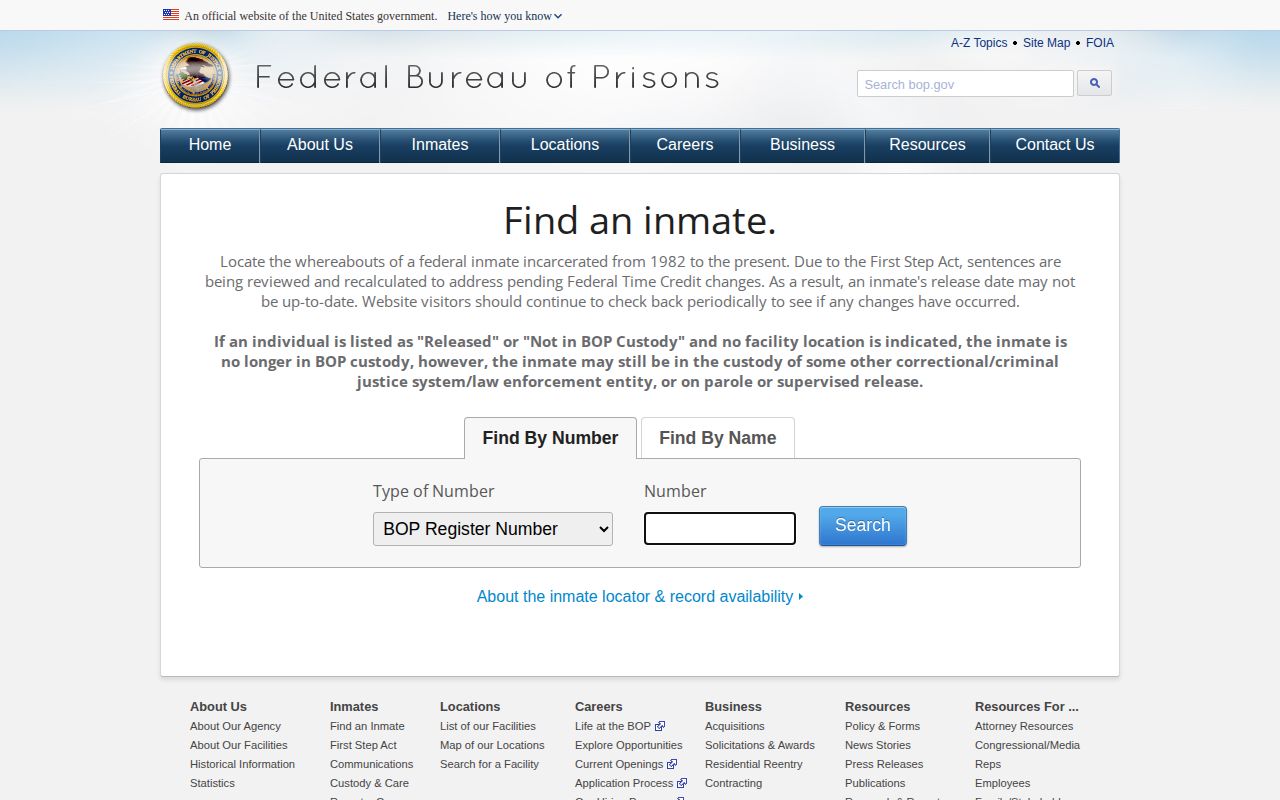
The screenshot identifies the correct BOP portal. It does not establish federal custody for a person who only appeared in the Pawnee County Jail system.
Read Federal Release Status Carefully
BOP explains that a Released or Not in BOP Custody result with no facility means the person is no longer held by BOP. Another justice or law-enforcement agency may still hold the person, and parole or supervised release may continue. The label is not a statement that every legal restriction or custody matter ended. It also does not reveal the physical exit from Pawnee County Jail.
- BOP custody
- Federal sentenced custody administered by the Bureau of Prisons.
- USMS custody
- Federal pretrial, detention, transport, and prisoner-operation custody that may use contract jails.
- Supervised release
- A court-ordered period of federal community supervision following imprisonment.
- Transfer
- A handoff from one custodian to another, rather than release to the community.
- Register number
- The federal BOP identifier used to match a person more reliably than name alone.
The BOP information about inmate records also warns that First Step Act recalculations can make release dates temporarily out of date. A displayed date should be tied to the retrieval date and checked again when timing matters.
Note: no BOP result is a substitute for the Pawnee sheriff's release destination when the question begins with a county booking.
Federal Release Lookup Fields
A BOP result can show a register number, age, race, sex, release date, and location or status. These fields help identify the correct person and understand the BOP stage. They should not be republished in excess merely to demonstrate matching. Use the least sensitive information needed to avoid a namesake error.
| Field | Use |
|---|---|
| Register number | Match the federal identity and case records |
| Age, race, and sex | Resolve namesakes when an identifier is unavailable |
| Release date | Read as the date displayed by BOP and recheck for recalculation |
| Location or status | Determine whether BOP names a facility or indicates the end of BOP custody |
BOP records before 1982 may require the National Archives. BOP advises providing the full and middle name, date of birth or age, race, and approximate dates of confinement to NARA. That older-record route is different from a live locator search and should be used only when the time period calls for it.
The BOP scope page appears in the project image below:
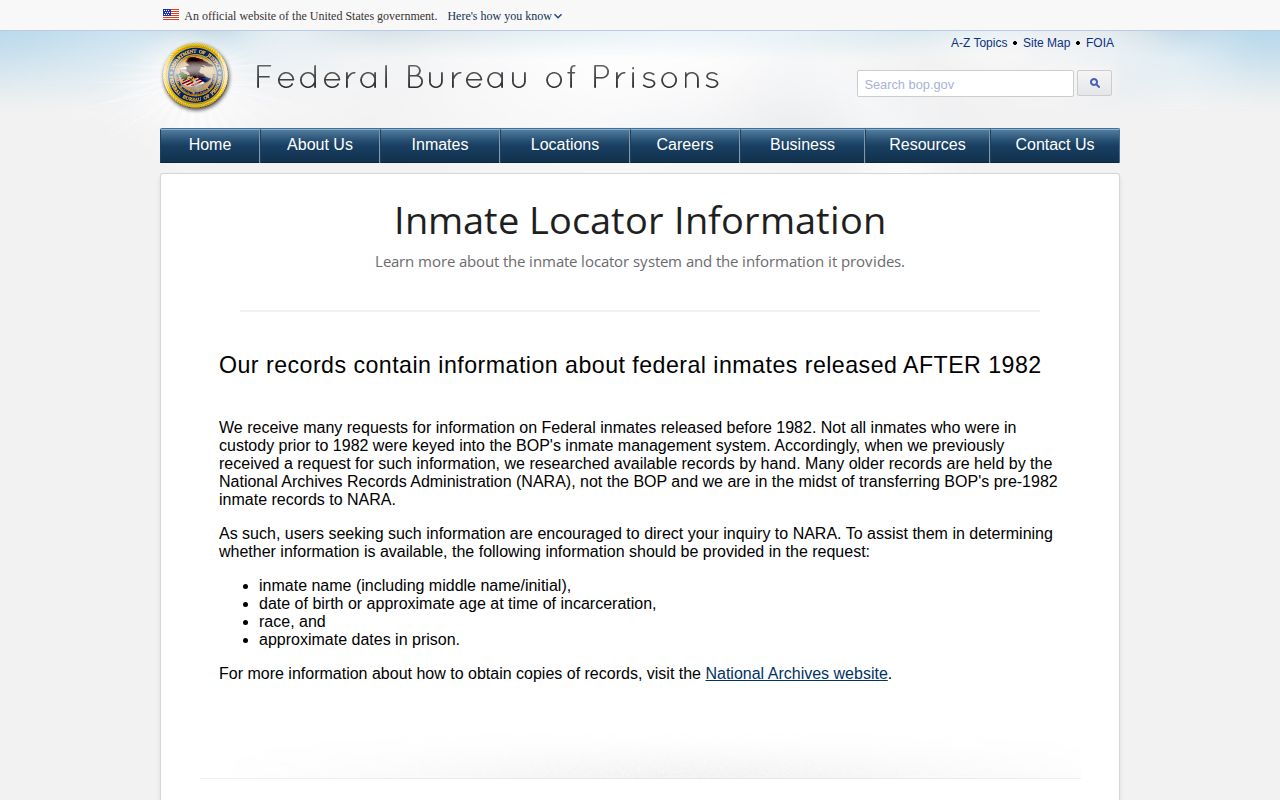
The source explains why federal search coverage and date limits must be stated before drawing a conclusion from a missing result.
USMS Pawnee Custody Records
USMS does not offer a public historical inmate-release locator comparable to BOP. Its prisoner-operations role includes detention and transport, and contract county-jail beds may be used. A person held for USMS can remain outside the sentenced BOP lookup. When BOP returns no match, the absence may reflect custody stage rather than release.
Use PACER or the relevant federal clerk for the criminal docket. Look for a detention order, conditions of release, remand, judgment, sentence, or later supervised-release action. The docket supplies legal context, not a real-time jail door timestamp. A USMS record request through the USMS FOIA channel can seek agency records for custody or transport.
A focused request should identify the person, federal case number, approximate custody dates, and the specific record sought. Ask for public portions and the legal basis of any withheld part. The agency may lawfully redact protected or security-sensitive information. If a county contract jail physically held the person, request that jail's release or transfer record as well.
Federal Court Release Confirmation
The federal court answers the legal side of release. An order may set conditions, grant pretrial release, remand a person, impose imprisonment, or establish supervised release after custody. It may be entered before the holding jail finishes processing, so the docket time should not be labeled as the physical exit time without a matching custodian record.
Read the case in order. Confirm identity by case number, then locate the detention or release order, judgment, and later filings. If the BOP locator shows a date, compare it with the judgment and any modification. A later revocation or warrant belongs to a separate event and should not be merged into the earlier release.
For a Pawnee-origin case, the sheriff record can establish when county custody ended. The federal docket can show why the federal process began. USMS may account for the next detention stage, and BOP may account for sentenced custody. Each source should be allowed to answer only the fact it maintains.
Note: a federal release order may precede transport, identity checks, or processing by the jail that physically holds the person.
Pawnee County Federal Transfers
A name removed from the Pawnee County Jail roster may have been released to the community or transferred. Call the jail and request the public release record. Ask for the release date and time, disposition, receiving agency, and destination. If the record says USMS or another federal agency, then move to federal sources. A current roster disappearance without that bridge does not prove federal adoption of the case.
The sheriff's roster updates hourly and is present-custody only. Its 24-hour and 72-hour pages are recent booking reports, not release lists. VINE can provide a transmitted custody event, but it does not provide the complete federal legal path. The state court docket may show local activity, while the federal docket governs the federal matter.
The full Pawnee County release search can be used to build the county side of the record chain before checking federal custody. Keeping the systems separate prevents a BOP result for a namesake from being treated as the outcome of a local booking.
Pawnee Tribal Federal Custody
Tribal jurisdiction does not itself identify federal custody or a detention building. BIA District II states that it has no detention facilities or staff and contracts county-jail services. Pawnee Nation Police provides law-enforcement jurisdiction and contact information, but the actual jail and court must still be identified.
In a federal Indian-country matter, a county contract jail may hold a USMS detainee. The person may not appear in BOP before sentencing, if ever. Ask which jail holds the booking, locate the federal case, and determine which agency has custody at each stage. Do not select BOP only because the arrest has a federal or tribal connection.
BIA District II and Pawnee Nation law enforcement document the local jurisdiction and contract-detention distinction. Their agency pages do not serve as federal release locators.
Build a Federal Release Record
A complete record chain may include four documents. The Pawnee sheriff release sheet establishes the county exit and destination. The federal detention or release order supplies legal authority. USMS records may document pretrial custody and transport. BOP supplies the sentenced-custody status and displayed release date. Not every case will involve all four.
When sources conflict, preserve exact labels and retrieval times. BOP dates may change after recalculation. A court order may precede physical processing. A county roster refresh may occur after a handoff. Contact the office that owns the disputed fact and ask whether a correction or later record exists.
No federal facility, public USMS locator, or federal released-person feed was verified in Pawnee County. The absence of a local building does not make the county roster a federal search. It means the inquiry must follow the documented receiving custodian and custody stage.